The Systems view of the world says that there are three things that come together to create a system: (a) The Elements or entities of a system, (b) their inter-connections and (c) the purpose or function of the system. Elements can be things such as people, teams, resources, etc. Inter-connections are the things that connect the different elements together, such as processes, reporting relationships, input/output flows. Purpose of the system is the reason the elements have been brought together. The Systems view also says that when we set out to change a system to achieve some outcome, we need to identify points of intervention. These points of intervention can be ordered from highest leverage to lowest leverage, depending on our understanding of the effort vs impact. Systems view also says that when changing a system, highest leverage exists in defining or redefining the purpose of the system. Although never the easiest thing to do in an existing system, changing purpose or redefining its reason-to-exist can make the most difference in the day-to-day activities carried out by the elements of the system. The second and third in order of the leverage are interventions at the level of interconnections and the elements themselves, respectively. One of the implications is that when managers consider replacing individuals in a team in the hope of fixing a problem, they are usually considering the lowest leverage solution.
In the process of strategy formulation such as the easy-to-follow Strategy Choice Cascade created by Roger Martin, the first decision that Roger Martin says we should take is to define the Purpose of the enterprise. This involves questions such as “why are we here and what is our reason-to-exist?”
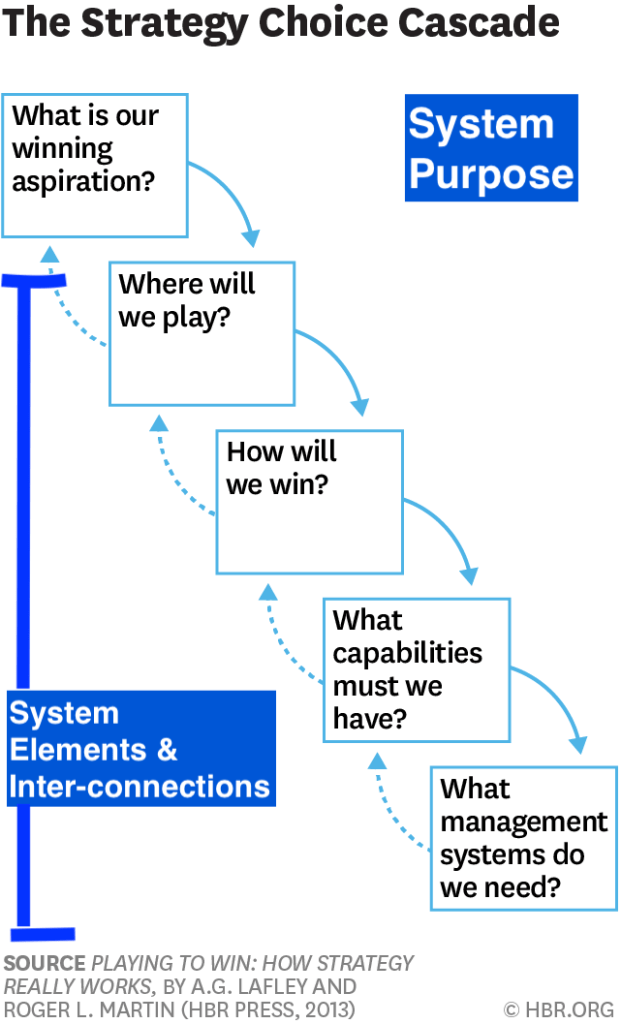
If you track the path of the Cascade in the diagram above, you’ll notice that the management systems and capabilities needed for accomplishing the higher leverage decisions comes last.
In a way this model basically says that “Structure follows Strategy” in that the org structure, management capabilities, etc. must be devised to support the strategy and purpose of the organization. This is congruent with the systems view that the purpose is the highest leverage point of intervention.
The attractiveness of strategy choice cascade to executives and founders lies in the fact that it clearly shows that the highest leverage decisions seem to be higher-up, primary, predominant, exec-level…insert whatever word makes it feel like those decisions are paramount, the domain of executives and that every other decision must roll-up or support or be in alignment.
This top-down view of the strategy cascade is also attractive because it appears to turn a set of complex, non-linear decisions into a linear process. It makes the process of strategy formulation as simple as starting from the top and working your way down. As Roger Martin has explained, this is a flawed interpretation. It happens because we ignore the backward pointing arrows into higher level decisions. Those arrows are supposed to say that each decision at the lower levels must inform, adjust, re-adjust, re-align all other higher level decisions till we converge on a strategy that satisfies the constraints at each level.
Time to Smell the Coffee
The implication of the backward pointing arrows is that strategy can be the result of an intentional structure, where the structure can be shown to be of such high impact that we must recognize its role in adjusting our aspirations, product scope, etc.
 Below Water Level
One response to “Where Systems and Strategy Intersect”
[…] a range of dysfunctions when delivering on strategy. Some times it is better to let small team structure determine strategy, instead of creating team structures to support a strategy. Small team is a starting point of […]
LikeLike