Common sense about TAM expansion is broken. To get TAM expansions right, founders and leaders must look inwards to themselves and their organisations, instead of the exciting opportunities outside.

Mind-making over Decision-making
Startups have the luxury of many problems to solve. Many of these problems will be interesting ones. Some of these problems can even be highly lucrative and some can lead to outsized returns.
So how is one to navigate opportunity selection?
There is a certain kind of introspection that provides a perspective no analysis in the world does. This mind-work must preceed technical and analytical work.
Self-awareness
The most important thing that founders and leaders must develop is self-awareness. If someone has convinced him or herself of it, then even the most analytically unattractive moves will look interesting.
What am I really feeling about this decision? How is my ego or vanity forcing my hand? Is greed at play or some stress at home thats driving the decision? Is fear or comparison to other CEOs making me take this step?
The voice in our heads is a strong force. Unless we unpack and dissect them, our emotions lead to local optimization or worse. We can convince ourselves that we have a strong hand when we have none. We may deliberately avoid analysis that may hide the true picture. Not knowing where that “gut-feel” is coming from is a potential for failure.
Becoming aware of oneself is the way to start.
Customer Voice
No customer ever said, “Please expand your TAM”.
No customer ever said, “Please provide more services and make more variety of products”.
No customer ever demanded that we become a big company.
Do customers really care about our TAM expansion? Despite this being one of the most critical decisions in a business, we proceed without accounting for what customers have to say about it.
Customers will not tell us, “Yes, please go ahead” or “No, this is no good”. As stewards of a product or service, and as a sacred responsibility that customers bestow on us, it is our job to keep existing customers’ interest front and center.
Is Your Org Ready for it?
TAM expansions are a message to the company. How strongly are you messaging: The new TAM is our future.
If you expand TAM enough times, it feels like the company is always on the lookout for the next shiny object. How are you avoiding perverse incentives for the org to ignore existing business? Are promotions being given for working on the new thing? Are people in the new area recognized more than others?
Is the added organizational heft worth the benefits? Are your people ready to take on more? Is your exec team ready to handle more demands on their time and attention?
These are not JUST questions of culture and human relationships but critical strategy issues. These questions will determine how well the org you have can or cannot support the new direction. TAM expansion decisions cannot be based on the company you wish you had. At some point in a startup’s life, the company and the team is larger than the founder. No diktat or directives will deliver the goods unless you’ve been preparing the org for it.
A Brand’s Place in the Customer’s Mind
Your solution already occupies a particular space in the mind of your customers. What does that space imply to them? What meaning do they associate with you and your company’s name?
These are not questions of just marketing. Customers internalize the purpose of each product and solution. That internalization means that every expansion into doing “more” or going after “more”, requires changes to that meaning. How will you navigate that change? How will customers navigate that change?
Attracted By Design
Many TAM expansions are masked under the garb of:
- extension in product design, or
- simply completing the user experience, or
- completing the platform, or
- offering more value, or
- increasing coverage of the end-to-end life cycle.
Just because the design and conceptual completeness make sense, does not mean that it makes great business sense. This usually happens when one fails to account for alternatives that already exist in the adjacencies.
What makes us better suited than those alternatives? Are we best suited to address this problem? What is eventually our purpose?
Attracted By Ease
Many TAM expansions are approved because it was just a simple addition to the product. Just because it can be done, doesn’t mean it should be done.
Protecting What You’ve Built
Some companies want to hop to new markets to be more lucrative investment targets. They usually forget to protect the business that they have. This problem is compounded when the disease spreads to the whole org through messaging that new business is more important than the existing business.
This is not an argument in favour of intertia. Instead, an argument for taking a step back, taking a deep breath and asking some critical questions about motivations and emotions that drive leadership behaviour.
Reversible Decision is Not So Reversible
Many businesses think that the door they are crossing is a reversible door, i.e. it will be easy to come back or revert the decision to enter a new TAM.
What you think is reversible is not so. Once the new money starts coming in(regardless of how unprofitable or margin diluting it may be), the new team is setup, the reports are sent to the board, careers are aligned to the new direction, entrenched interests take over. Feeding the beast becomes an end goal in itself.
Overcome Founder Mode
Many founders and leaders believe they will be able to overcome internal org obstacles by working in the so called Founder Move. It certainly works but only to an extent. Founders and leaders cannot themselves be everywhere. When they think they can be everywhere, which is the original attraction of operating in Founder Mode, that is itself a major sign of lack of self- and org-awareness.
Even when leaders operate in “Founder Mode”, they will not be able to overcome org obstacles without a deep, personal introspection about their own original motivations with they initiated the TAM expansion. Employees are not stupid. Humans are deeply social animals and the survival radar in all of us is able to instantly recognize signals of fear, greed, insecurity, vanity, emotions that have many times lead to TAM expansions, at the cost of building a great business or at the cost of serving the cause of the customers. When employees observe this in their leaders, automatic response is to enter protection and survival mode themselves. This leads to optimizing for their own teams, fiefdoms, careers and compensation.
Apple’s Example
Most companies are limited by money to take on TAM expansions but the best examples to study are those who have the cash and the discipline in deploying it. Benedict Evans provided a glimpse of this in a recent article about Apple that is worth reading.
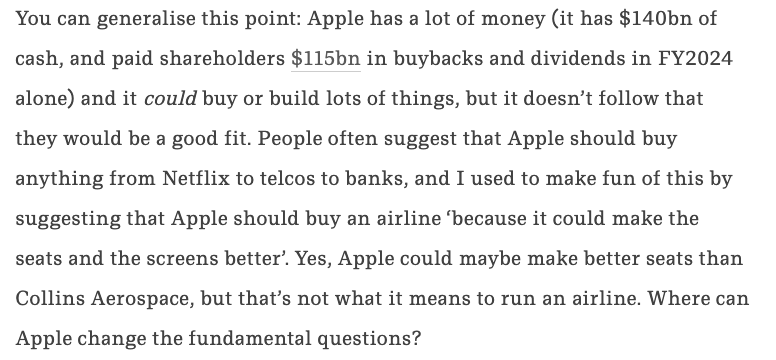
One could argue that it is not the cash reserves that is prompting Apple to be so disciplined and introspective, but rather that they have gathered so much cash because they have been disciplined and introspective.
Further Reading
- A recent Roger Martin article on the challenges faced by Starbucks is timely reminder of challenges of TAM expansions. These decisions are never easy. Just as tempting as it is to expand TAM, it is also a very … very slippery slope. Most businesses slip and break a bone along with the bank.
- Writing in 1997, the marketing guru, David A. Aaker wrote:
The battlefield is littered with dead and wounded brands that should serve as a warning to managers who are thinking about such extensions.
But this caution is generally thrown to the wind by managers.
When markets turn hostile, … managers are tempted … to take brands into a seemingly attractive market above or below their current positions. - Book: Deliberate Calm: How to Learn and Lead in a Volatile World
- Learning Leadership from the Inside Out by Hitendra Wadhwa and his book.
 Below Water Level