How to drink from the firehose of customer feedback without drowning? Start by thinking of yourself as the Product Manager or Designer of the in-house Customer Feedback Management practice.
Start by charting out what your current information flow is. Answer the following questions for your company and you will start to see the structure of information flows.
- Where does feedback really start from?
- What is the end state of a piece of feedback?
- Once a piece of feedback enters your system, who is it supposed to go to first? What are they supposed to do with it?
- Who is responsible for the different steps in the journey of a piece of customer feedback?
- Do your customers expect a brief-back on the status of a piece of their feedback? How will that work?
- If not customers, do internal stakeholders expect a brief-back on feedback items they have been involved in? How will that work?
Model Your Information Flow
Once you’ve figured out what the flow of feedback is, record it like a flowchart so it is clear to everyone.
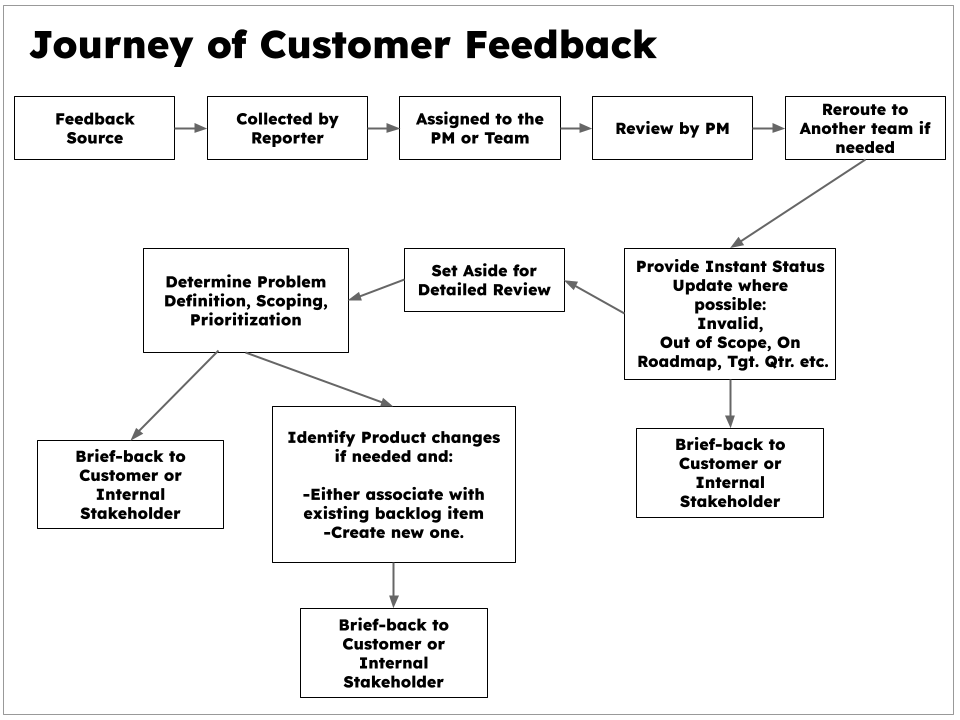
This flow looks linear but in reality, there are loops. The important ones that usually require investing significant time from PMs are:
- Seeking clarifications from the person who has posted the feedback.
- Briefing-back the customer and internal stakeholders on the feedback given in the past.
- Collecting feedback items that look related for the sake of better problem definition and scoping.
- Personally digging into specific feedback items with customer calls.
Where does feedback start from?
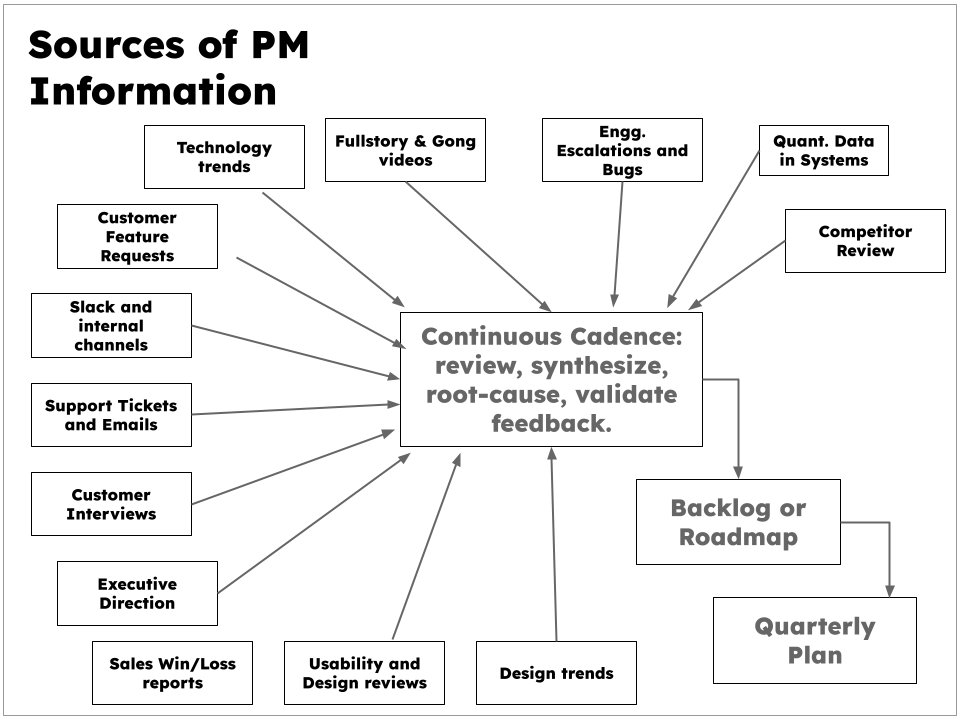
Try to create an exhaustive list of all the touch-points, people, processes, etc. that result in information being routed to you. The following diagram is a representation of how we modelled this at Airbase.
What is the end state of a piece of feedback?
You may find that many pieces of feedback do not ever need to be considered further. Or, there may be others that need to be connected back to proposals already in the roadmap. What are these states that you need to reflect for feedback. Here are some samples:
- Invalid
- Out-of-Scope
- On Roadmap
- Tgt Qtr, etc.
Modelling Feedback Items
Through this exercise, you will also need to consider what attributes need to be associated with each feedback item. Does it need to be tagged to teams, individuals, product areas, subsystems? Do you ever end up merging different feedback items to consolidate into a single feature or change? How would you track all that?
Once you have thought through the above issues and brought about an alignment with other PMs and stakeholders about it, that is when you should think about what kind of a system of record helps execute this with ease.
 Below Water Level
One response to “Drinking from the Feedback Firehose”
[…] Lately I’ve been jamming on the issue of management of customer feedback[Post1, Post2, Post3]. […]
LikeLike